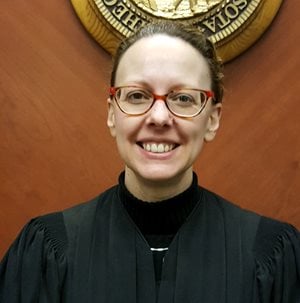
The irony of being named Clysdale and having a face like a horse with teeth that could eat soup through a picket fence.
Why It Matters
The extensive civil rights litigation naming Clysdale waves a red flag for due process and record integrity in Ramsey County's high-volume civil HRO factory. At $300 a pop, there's a lot of easy money to be made- a flow that depends on feeding the machine with cash-heavy Petitioners and unaware Respondents.
The Blind Gavel
Some people run a courtroom like a hall of justice; Elizabeth Clysdale runs it like a high-volume assembly line where the conveyor belt only moves in one direction: her pockets. You don't even have to be in the same state to feel the weight of her wrath in your wallet. In fact, it works better for her if you aren't.
Four times the court met in the quiet dark. Four separate hearings went on the record, moving through the cash-hungry machinery without a whisper of notice ever hitting the Author's mailbox.
Despite never having stood before her bench, never having looked her in the eye, and never having the chance to utter a single word of defense: on December 12, 2024, unbeknownst to the Arizona-based Author: a trap had been set from four states away.
Refereee Clysdale handed down a default Harassment Restraining Order, empty of any allegations and lacking any oversight. Unsigned by a judge, unknown to the author, served by no one: a ghost in the Ramsey Coounty machine.
In Clysdale's corner of St. Paul, procedure isn't a safeguard; it's a way to pad the judiciary's pockets.
The Order in Two Timestamps
The December 12, 2024 HRO in Lee v. Strickland, 62-HR-CV-24-963, is preserved in The Author’s Scanned Originals folder in a single physical form. Every page carries the Ramsey County filing stamp 12:42 PM. The referee-signature block reads “E. Clysdale (Clysdale, Elizabeth, Referee), Dec 12, 2024 12:42 PM.” The “Judge of District Court” countersignature line beneath it is blank. The date fields to the left of both signature lines are blank too.
According to the affidavit from petitioner Madeline Lee, a second version of that same order exists in the court file — time-stamped 4:38 PM the same day, with a judge’s signature added. Three hours fifty-six minutes between them. The Author’s served copy is Version A. Where Version B lives, and what its face looks like, has not been directly compared against the served copy.
Three neutral candidate explanations rank from most benign to most concerning:
- Ordinary workflow. Referee signs, file walks to a duty judge for countersignature, countersigned version is scanned and re-filed. A four-hour turnaround is consistent with a busy administrative day.
- Nunc pro tunc replacement. Version A was filed prematurely by clerk error, then withdrawn and replaced. Under § 484.70 subd. 7(e), only Version B would be legally effective; Version A should have been marked withdrawn on the docket. It was not.
- Post-service reconstruction. Version A was served on the party. Version B was inserted only in the electronic file. That would match The Author’s statement on the record at the August 19, 2025 hearing that “some of the copies they gave me were altered to add signatures of judges that were never on the copies that I had.”
Under Griffis v. Luban, 601 N.W.2d 712 (Minn. Ct. App. 1999), if Version A is what was served and Version B was substituted only in the court’s electronic file, the HRO in force during any relevant service or enforcement window was uncountersigned and therefore had no effect under Minn. Stat. § 484.70, subd. 7(e). Every downstream act premised on the HRO — enforcement, the May 23, 2025 order denying the motion to vacate, the July 31, 2025 Larmouth recusal order, the August 19, 2025 Starr collateral-estoppel dismissal — rests on that potential nullity.
Three hours fifty-six minutes between the signature and the signature that made it stick.
The Paper Trail of Clysdale's Harm
When a referee spends years working the high-velocity dockets of the Domestic Abuse and Harassment calendars, they start leaving a trail of smoke.
The institutional armor is thick (immunity is a hell of a drug) but the federal docket keeps the receipts. She was dragged into the Author's federal civil rights case because of her fast-and-loose hand with the HRO machinery, but Clysdale is no stranger to the inside of a defense brief.
Brock Fredin dragged her all the way up to the Eighth Circuit Court of Appeals. He alleged a bitter cocktail of abuse of process, constitutional overreach, and a system that converts social media noise into years-long legal battles, and judicial gag orders in place of proper civil litigation. The state hid behind its usual procedural shields, but the pattern was already cut into the stone.
By 2025, the cracks in the bench were showing wider. Abel Aaron Nelson took Clysdale to federal court in a sprawling Section 1983 action, chasing her all the way through a messy divorce docket where she stripped millions in assets.
The twist? Nelson caught her living across state lines in Wisconsin, arguing she was constitutionally disqualified from holding a Minnesota district seat.
The federal court ultimately ducked the issue under the Rooker-Feldman doctrine, hiding behind the rule that federal judges don't clean up state-court spills, but the truth spilled into the docket anyway.
The names change, but the exhaustion stays the same.
The Wisconsin Tell
In 2015 — the year Ramsey County appointed Elizabeth Clysdale a referee — she was admitted to the Wisconsin bar. Her Wisconsin status is now listed as Resigned. Both facts appear on her public Avvo profile.
A Minnesota-licensed lawyer taking a Wisconsin bar admission the same year she takes a Minnesota judicial-officer appointment is a documented data point. In the federal § 1983 suit Nelson v. Clysdale, No. 25-cv-1404 (D. Minn.), the plaintiff alleged Clysdale was living across the state line in Wisconsin during her Ramsey County referee tenure and was therefore constitutionally disqualified from a Minnesota judicial post. The Minnesota Court of Appeals answered the disqualification question in a companion order, In re Nelson, A24-1582 (Minn. Ct. App. Oct. 15, 2024), holding Minn. Const. Art. VI § 4’s residency requirement applies to district judges, not to referees. The federal court dismissed Nelson’s case on Rooker-Feldman grounds without reaching the residency question on the merits.
What that leaves on the record is not a legal disqualification. It is documentary corroboration that Nelson did not invent the Wisconsin angle. The 2015 Wisconsin bar admission is there. The “Resigned” status is there. Whatever Clysdale’s residency actually was, the bar record shows a two-state professional footprint during the years she was signing HROs in Ramsey County.
Cross-border credential, single-state bench, one year that lit them both up.
The Room Called Collins Buckley
Before the bench: partner at Collins, Buckley, Sauntry & Haugh, PLLP, a St. Paul family-law firm, from roughly 2005 to mid-2015 — the year Ramsey County elevated her to referee. Same firm. Same practice area. Same clients.
Victoria Elsmore — now sitting on the Ramsey County bench as Judge Victoria Gardner — joined Collins Buckley later that same year. Elsmore’s tenure at CBSH ran from 2015 through her own appointment as a Ramsey County Family Court referee under Chief Judge Grewing. The two referees’ time inside Collins Buckley’s door overlaps in calendar-year 2015.
Two Ramsey County family-court referees, both signing HROs in The Author’s corpus with blank countersignature lines, both alumni of William Mitchell College of Law, both partners at the same seven-attorney St. Paul family-law firm, running consecutively into the referee bench across a single hiring cycle. Elsmore later sat on the Mitchell Hamline Board of Trustees. Clysdale co-authored a Ramsey Housing Court article in Mitchell Hamline’s Journal of Public Policy & Practice. The same law school appears twice on the shelf. The same firm appears once on both résumés.
This is not a conspiracy claim. It is documentation of a small, recurring room — a bar leadership club, a firm, a law school, an alumni body — whose members keep landing on the same bench.
Same room. Same door. Same door handle, worn smooth.
Summary of Execution
In a high-volume system, speed is the only metric that matters, and adversarial testing is nothing more than a speed bump. Litigants without wealth or insider access get ground into dust by a $300 filing fee and an absolute absence of due process.
The orders flow out of Ramsey County, often lacking a proper judicial signature, effective the second her pen hits the page. She remains a fixture of the Second Judicial District: an official gatekeeper who treats notice as an option and the federal civil rights docket as a cost of doing business.
Social media has no place in the courts
References & Sources
Every claim of fact on this page is supported by publicly sourced evidence. The links below are the primary references.
- MN Judicial Branch — Referee Elizabeth A. Clysdale official bio (Bio.aspx?jid=1458)
- Avvo — Elizabeth Clysdale profile (bar admissions: MN 2004; WI 2015 Resigned)
- Fredin v. Clysdale, 8th Cir. (2020) — appeal disposition
- Fredin v. Clysdale, D. Minn. (2018) — R&R and docket history
- Nelson v. Clysdale, D. Minn. 25-cv-1404 — MTD order (July 17, 2025) — Rooker-Feldman dismissal
- Nelson v. Clysdale, 8th Cir. No. 25-2469 — pending appeal docket
- In re Nelson, A24-1582 (Minn. Ct. App. Oct. 15, 2024) — held Minn. Const. Art. VI § 4 residency requirement does not apply to referees
- Nelson v. Derry, A24-1135 (Minn. Ct. App. May 27, 2025) — dissolution amended decree affirmed; district court note that decree WAS countersigned
- Volokh / Reason.com — "Minnesota Court Apparently Orders Man Not To…" (May 8, 2018) — critique of Middlecamp v. Fredin HRO
- MN CLE Divorce Practice Deskbook — Ch. 20 (Clysdale)
- Mitchell Hamline J. Public Policy & Practice — 2020 Ramsey Housing Court article (Clysdale co-author)
- Griffis v. Luban, 601 N.W.2d 712 (Minn. Ct. App. 1999) — Second-District case; uncountersigned referee orders "unauthorized"
- Minn. Stat. § 484.70 — referees; subd. 7(e) countersignature requirement
- Minn. Stat. § 609.748 — HRO carve-outs at subds. 4(b) and 5(b)
- Minnesota Judicial Branch — Ramsey County HRO fee schedule
- LawHelpMN — OFP/HRO overview (fees & waivers)