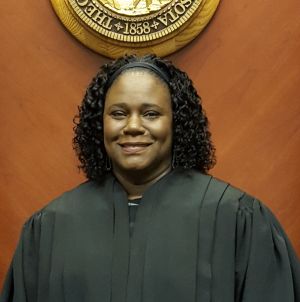
Referee Jenese Larmouth, Ramsey County Judicial Officer
Nominally neutral, actually named as a civil-rights defendant, and still signing orders as if nothing has changed.
Key Context
- Presiding referee in the harassment-restraining-order case that spawned Strickland v. Ramsey County et al.
- Named as a defendant in the federal civil-rights suit while continuing to act in the underlying state case.
- Issued and relied on unsigned and later retro-signed orders, contributing to an unstable and contradictory record.
- Denied an evidentiary hearing despite statutory entitlement, preventing testimony under oath.
- Copied on appellate-related orders and notices even after being named in federal litigation, reinforcing her central role in a system under scrutiny.
- Former Assistant County Attorney for Ramsey County; counsel of record in A14-1955 and recipient of a 2017 petty-misdemeanor traffic conviction (62-VB-17-84912).
Why It Matters
Every broken system has a human interface. In Ramsey County's harassment docket, that interface is Referee Jenese Larmouth.
She is the judicial officer who turned a comment-section dispute into a civil HRO, refused an evidentiary hearing, issued orders without signatures, and then watched as those same defective documents were retro-signed, re-dated, and exported into other courts as if they were reliable artifacts. She is also a named defendant in the federal civil-rights case that grew out of that mess, yet continued to act in it as if the conflict were optional.
When a referee presides over a case, becomes a defendant in the resulting federal lawsuit, and still allows her name and authority to be used on orders correcting or extending her own conduct, the problem is not one bad ruling. It is a failure of basic judicial ethics and an attack on the idea that records mean anything at all.
This page exists because the record keeps trying to erase what she did. The neon is here to make sure it does not.
Staying On The Case After Becoming A Defendant
By the time the federal complaint in Strickland v. Ramsey County et al. was filed, Referee Larmouth had already been put on notice that her conduct in the HRO proceedings was at issue: denial of ADA accommodations, refusal to hold an evidentiary hearing, and reliance on altered and unsigned orders. The complaint named her personally as a civil-rights defendant.
A judge or referee aware of being named in related litigation is supposed to step back. Instead, Larmouth stayed exactly where she was. She continued to rule on motions that directly implicated her own behavior, including requests aimed at correcting the very record she had helped destabilize. Only later did she quietly exit, after using her position to lock in a version of events that favored the institution over the person asking for help.
In any other context, deciding your own case is called a conflict of interest. On her bench, it was just another hearing.
Unsigned Orders And A Manufactured Record
One of the core problems in the harassment case was simple and catastrophic: orders were issued without signatures, then treated as if they were final, enforceable, and valid. Larmouth was the judicial officer whose name and authority were attached to those ghost documents.
She denied an evidentiary hearing despite statutory entitlement, ensured no witness ever had to answer questions under oath, and allowed the case to proceed on paper alone. Then, when orders appeared in the file without signatures or with signature pages added later, nothing was corrected. No amended order was issued to acknowledge the defect. No notice was sent to say, in plain language, that the court had released a noncompliant document.
Those same orders later resurfaced with retroactive signatures and re-dated metadata, and were eventually carried into federal court by county counsel as if they were clean. The result is a record that behaves like a glitching video file: the same order with different timestamps, the same docket entry with different contents, all funneling back to one referee who never once acknowledged the problem.
When the referee will not admit the file is corrupt, the corruption becomes the file.
Appeals, Copies, And The Illusion Of Oversight
The Minnesota Court of Appeals has identified Larmouth as the judicial officer who conducted the underlying HRO proceedings. In a November 2025 order denying a motion to intervene, the Court anchors the challenged orders in her courtroom while declining to address the full federal implications. Even there, the system cannot talk about the case without saying her name.
At the same time, Ramsey County has developed a strange habit: routing orders and notices past Larmouth even when other judicial officers' names are on the caption. She is copied on appellate-related correspondence, looped into denials, and positioned as the quiet recipient of documents describing the damage done in proceedings she controlled.
The message this sends inside the courthouse is simple: no matter who signs the next order, the referee whose actions triggered the federal lawsuit is still in the loop, watching from the system console. The message it sends outside the courthouse is worse: the people responsible for the broken record are now supervising the cleanup.
Prosecutor To Referee: The Same Gravity, New Robes
Before taking the bench as a referee, Larmouth worked as an Assistant County Attorney under Ramsey County Attorney John Choi. In the published opinion State v. Gibson, A14-1955, she appears as counsel for the State, defending the government's position in a criminal appeal. The posture is familiar: resist relief, defend the record, protect the institution.
That same gravity followed her to the referee's chair. Her decisions in the harassment case consistently bent toward institutional convenience and away from access: no evidentiary hearing, unsigned orders left uncorrected, ADA barriers treated as personal failures rather than legal violations, and continued involvement after becoming a named defendant.
Public records also show a petty-misdemeanor traffic conviction (obscured plate, 2017, Case No. 62-VB-17-84912) resolved by administrative fine. It is minor, but it underscores a familiar contrast: when insiders make mistakes, the system offers quiet resolution. When disabled pro se litigants trip on barriers the court itself erected, it calls them noncompliant and uses the resulting confusion as justification to shut the door.
Change the job title from prosecutor to referee and the costume changes, but the role does not.
References
- Strickland v. Ramsey County - Federal Complaint and Exhibits (recusal, unsigned orders, ADA record)
- State v. Gibson, A14-1955 (Minn. Ct. App. June 22, 2015) - Larmouth as Assistant County Attorney
- MCRO Register - 62-VB-17-84912 (2017 obscured-plate violation)
- Minn. Ct. App. November 2025 Order - denial of motion to intervene, identifying Larmouth as HRO referee