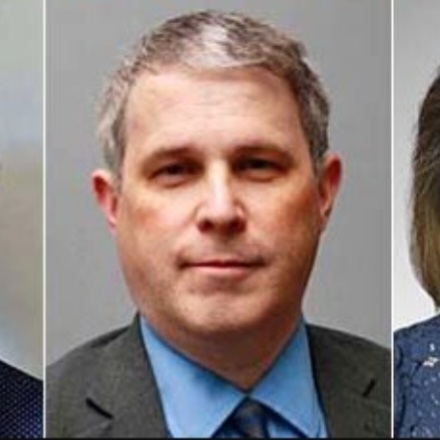
Why It Matters
Procedural fairness requires more than deadlines and fees. It demands clarity — especially when a case is closed without motion or hearing. In my civil stalking suit, a sua sponte dismissal by an unassigned judge was followed by a fee warning from Upton's office: pay $100 to reopen.
In housing court, Upton's initiatives promote collaborative, no-cost resolution. But in non-housing civil litigation, that ethic vanished. The result was a Kafkaesque loop: a case dismissed without process, and access to review contingent on payment — without any clear legal basis.
The Office of the Legislative Auditor initiated a preliminary review into these practices. It declined to escalate. Still, the questions remain: when did court administration become an arbiter of access? And how many litigants were turned away for lack of $100?
The civil division administrator whose attempt to charge a reopening fee followed a sua sponte dismissal that bears the same procedural signature.
Where He Actually Sits
Michael F. Upton is a Judicial Court Administration Manager II — State of Minnesota Judicial Branch, Agency Code J33, Job Code 009159, Department Code J332ad1, work location District 2 – Ramsey. That is the HR title. It is not the title that appears on the paperwork he signs.
On Ramsey County District Court probate notices, Upton signs as “Court Administrator” or “District Court Administrator” — a statutory designation under Minn. Stat. Ch. 485. Both titles are legally accurate; each applies to the divisional role he owns. Neither of them makes him the top of the org.
The top of the org is Heather M. Kendall, District Administrator of the Second Judicial District since January 5, 2015. Kendall is a William Mitchell College of Law J.D. and a member of the Minnesota Supreme Court’s Advisory Committee on the General Rules of Practice — the committee that drafts the rules the referee-signature-and-countersignature workflow this site tracks operates under. Kendall reports up to the Chief Judge. Upton reports up to Kendall.
Parallel to Upton, at the same Manager II salary tier, sits Donald W. Harper Jr. — hired August 7, 2019, named defendant in Strickland v. Rueger, and running a different divisional portfolio the state has not published. Below Upton on the probate signature block: Deputy Court Administrators Elizabeth Girling and Benjamin Linker, plus Probate Registrar Laura J. Stevens.
That is the chain of custody. Line clerk → Deputy Court Administrator → Manager II (Upton or Harper) → District Administrator (Kendall) → Chief Judge → Judicial Council. Every routing decision that touches a Ramsey probate filing runs through this hierarchy. Every fee-collection decision Upton’s office made in The Author’s civil case ran through it too.
The signature block reads Court Administrator. The org chart reads Manager Two.
Administrator by Tenure
Michael Upton has spent most of his professional life in the Twin Cities' legal administration, the last several years as Civil Division Administrator and, more recently, Deputy District Administrator for the Second Judicial District.
His public profile centers on collaborative housing court initiatives, tribunals convened to address the evaporation of eviction protections after the pandemic, and efforts to bring litigants and landlords together in structured settlement events.
Reports from 2023 document housing events where over 2,000 eviction cases were reviewed in concentrated calendars, aimed at early resolution and reduced displacement — a structural response to post-moratorium caseload surges.
Over 28 years in Minnesota's Second Judicial District, ascending through administrative ranks.
The Probate Signature Trail
Where the housing-court initiatives are the public half of Upton’s ledger, the probate signature block is the half that runs quietly. Every publicly indexed probate notice out of Ramsey County District Court in the documented window — from November 15, 2023 through July 3, 2025 — carries his signature. Estate of Diane Shuda. Estate of Bonnie Youngquist. Estate of Clifford Keizer. Estate of William Soshnik. Estate of John Hennessy. Estate of Ingeburg Hix. Estate of Lynn Bruski. Estate of Barbara Wilfahrt. Case prefixes 62-PR-23, 62-PR-24, 62-PR-25. On every one, the signature line reads “Michael F. Upton, Court Administrator” or the “District Court Administrator” variant. The “BY:” line under him rotates between Elizabeth Girling and Benjamin Linker. When Laura J. Stevens signs alongside him, her line reads “Probate Registrar.”
This is a stable, multi-year signature routine, not a one-off. It is the paper backbone of Ramsey County’s probate docket. In the specific structure of the Register of Actions manipulations at issue in Strickland, a Manager II is the level at which a floor-clerk’s “I can’t do this” becomes an “OK, do it this way.” If a filing gets accepted, rejected, docketed, redocketed, sealed, unsealed, or routed to a different calendar without judicial involvement, the sign-off happens at exactly the level Upton sits.
One of the probate matters in this signature trail — the Wilfahrt estate — is a Ramsey County Attorney’s Office-filed matter. Assistant Ramsey County Attorney Caitlin Mohamed is on the caption. That is a routine appearance; RCAO regularly appears in probate on Human Services collection matters. It is worth naming for what it is: a documented structural interaction between the Court Administration Manager who runs probate (Upton) and the county attorney’s office (Bacon’s office) that provides The Author’s federal defense counsel. Not a personal alignment. A hallway they share.
Every probate notice, one signature. Two years of decedents, one hand on the stamp.
Procedural Practice
In the broader administrative context, Upton's record reflects institutional coordination: multi-agency clinics, mediation calendars, and systemic approaches to housing disputes. But in my civil stalking case — closed sua sponte by a judge not assigned — his procedural visibility is different.
After the dismissal, Upton's office issued a notice that reopening the case would require a $100 motion fee. That instruction echoed the same fee-centric gestalt that precluded ordinary service and hearing in the first place.
In the ordinary course of civil practice, fees serve structure. But when a case evaporates without motion, notice, or service, the notion of a fee as a gateway to process becomes, at best, circular — and at worst, a barrier to access.
A preliminary review was opened by the Office of the Legislative Auditor (OLA) but declined for full investigation. The absence of clear procedural justification — coupled with repeated fee triggers — remains an unresolved administrative pattern.
Case closed without motion. Motion to reopen requires fee.
Two Lanes of Administration
Here, tenants and landlords meet on negotiated calendars; mediators, social services, and legal aid converge, producing settlements without trials. More than half of eviction actions in mid-2023 concluded this way, before adjudication.
In contrast, a civil claim of stalking never reached a hearing; instead it dissipated through mechanisms that neither party initiated. The administrative response was procedural — and fee bound.
In systems with discretion and complexity, patterns matter more than intentions. Upton's operational record is robust. Its application in the context of non-housing litigation remains opaque.
The same administrative architecture that brings dozens of eviction cases together in a day can also leave a single civil claim without a path to review — unless a fee is paid.
References & Sources
Every claim of fact on this page is supported by publicly sourced evidence. The links below are the primary references.
- OpenPayrolls — Michael F Upton 2023 pay detail (Manager II, D2-Ramsey, hire date 7/1/2003)
- OpenPayrolls — Michael F Upton 2017 pay detail (confirms Manager II class from 2017)
- OpenPayrolls — Michael F Upton career record
- MN Lawyer Public Notice #4004723 — Estate of Soshnik (Oct. 23, 2024) — Upton signature as Court Administrator
- Vadnais Heights Press Public Notices — Ramsey Probate filings July 2025 (multiple Upton signatures)
- Vadnais Heights Press Public Notices — Ramsey Probate filings December 2023 (Keizer, Shuda, Youngquist estates signed by Upton)
- MN Judicial Branch — Ramsey County District Court main page (Kendall as Court Administrator)
- Minn. Stat. Ch. 485 — statutory Court Administrator designation